Overview of 5G Technology: What 5G Means For The Future Of Internet Of Things
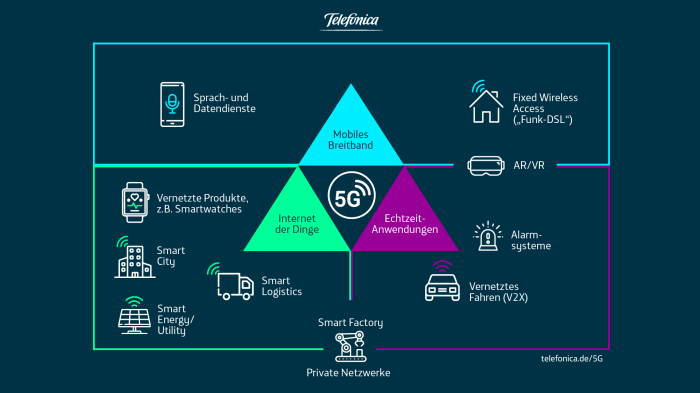
What 5G Means for the Future of Internet of Things – G technology represents a significant leap forward in mobile connectivity, introducing a suite of features designed to enhance the user experience and meet the demands of modern applications. With its ultra-fast speeds, reduced latency, and increased capacity, 5G is set to revolutionize how we connect and communicate.The fundamental features of 5G include:
- Higher Speeds: 5G can achieve download speeds up to 10 Gbps, significantly faster than 4G’s maximum of around 1 Gbps.
- Lower Latency: Latency can drop to as low as 1 millisecond, enabling real-time communication and interaction.
- Increased Connectivity: 5G can support up to 1 million devices per square kilometer, facilitating the growth of the Internet of Things (IoT).
The differences between 5G and previous generations of mobile networks are notable. While 4G primarily focused on improving mobile broadband for users, 5G aims to connect a vast array of devices, ensuring seamless communication across various sectors. This shift opens up new possibilities for industries ranging from healthcare to transportation.The potential benefits of 5G for users and industries are immense.
Industries can leverage enhanced data analytics and automation, while users will experience faster downloads and improved streaming quality.
Impact of 5G on the Internet of Things (IoT)
G significantly enhances IoT device connectivity and communication by providing a more robust infrastructure for device interconnectivity. This advancement allows IoT applications to operate more efficiently, driving innovation and transformation across various sectors.Key examples of IoT applications that stand to benefit from 5G include:
- Smart Homes: Devices like smart thermostats, lighting systems, and security cameras will operate more reliably and efficiently.
- Autonomous Vehicles: 5G will enable faster data exchange between vehicles and infrastructure, enhancing safety and navigation.
- Industrial Automation: Factories can implement more sophisticated automation systems, leading to increased productivity and reduced downtime.
With 5G, IoT networks will experience increased efficiency and data transfer speeds, allowing for real-time monitoring and analysis. This capability is crucial for industries that rely on timely data to make informed decisions.
Security Challenges and Solutions
The widespread adoption of 5G in IoT raises important security challenges. The increased number of connected devices creates a larger attack surface, making it easier for malicious actors to exploit vulnerabilities.Several security vulnerabilities that may arise include:
- Device Authentication: Ensuring that only authorized devices can access the network is crucial in preventing unauthorized access.
- Data Privacy: With increased data transfer, sensitive information could be intercepted if not properly secured.
- System Overload: The sheer volume of connected devices could lead to potential denial-of-service attacks.
To address these vulnerabilities, potential security measures include implementing robust authentication protocols and encryption techniques. Encryption plays a critical role in securing data transmitted over 5G networks, while proper authentication ensures that devices are verified before gaining access.
Use Cases of 5G in IoT
Various industries are transforming through 5G-enabled IoT solutions, showcasing the technology’s versatility. In smart cities, 5G facilitates the integration of various systems, including traffic management, public safety, and environmental monitoring. For instance, smart traffic lights can adjust in real-time based on traffic flow, reducing congestion and improving safety.Healthcare is also evolving with 5G-connected devices, allowing for remote monitoring of patients, real-time data transmission, and telemedicine services.
This transformation enhances patient care and streamlines healthcare operations.
Future Trends and Innovations
Anticipated developments in IoT technology propelled by 5G include the expansion of AI and machine learning capabilities, leading to smarter applications and services. As businesses increasingly adopt these technologies, new business models will emerge, creating economic opportunities across sectors.Expected advancements in various sectors due to 5G in IoT are summarized in the table below:
| Sector | Expected Advancement |
|---|---|
| Healthcare | Enhanced remote monitoring and telehealth services. |
| Transportation | Improved autonomous vehicle communication and safety systems. |
| Manufacturing | Increased automation and real-time monitoring of production lines. |
| Agriculture | Smart farming solutions for crop monitoring and management. |
| Smart Cities | Integrated systems for traffic, utilities, and emergency services. |
Global Adoption and Infrastructure, What 5G Means for the Future of Internet of Things
The current state of global 5G rollout is rapidly evolving, with many countries investing heavily in infrastructure to support IoT adoption. The implications of this rollout are profound, as increased connectivity can lead to enhanced economic growth and innovation.Infrastructure requirements necessary to support 5G for IoT applications include:
- Dense Network of Small Cells: To ensure signal strength and coverage in urban areas.
- Fiber Optic Cables: Essential for connecting base stations to the core network.
- Network Slicing: A technique that allows multiple virtual networks to operate on a single physical infrastructure, tailored for specific applications.
Regions leading in 5G implementation, such as South Korea, China, and parts of Europe, are significantly influencing global IoT trends. Their advancements set benchmarks for other countries striving to enhance their own IoT capabilities through 5G.